
Ever wonder what does the E means beside your phone signal strength?

This is the second generation of wireless technology. 2G radio signal are digital.
a) GPRS (General Packet Radio Service)
This is 2G but implemented with a packet-switched domain in addition to the circuit-switched domain. This mobile generation is dubbed as 2.5G
b) EDGE (Enhanced Data rates for GSM Evolution) [E]
This is still widely used around the world. EDGE have a better data transmission rates than previous versions of 2G, with maximum speed of 1 Mb/s. EDGE is dubbed as 2.75G
3G (3rd Generation) [3G]
This is the third generation of wireless technology. The minimum speed can be achieved through 3G is about 0.2Mb/s. 3G networks offer a better security than 2G. 3G is also used in variety of services like GPS and Mobile TV.
a) HSPA (High-Speed Packet Access) [H]
- HSPA is the combination of both HSDPA and HSUPA.
- Dubbed as 3.5G.
- HSPA can be upgraded to Dual-Carrier, which allows user to connect to 2 cell tower at the sametime to double the speed.
- There is also Multi Carrier HSPA connection, which will enhance the speed even further than Dual Carrier.
- The upgraded version of HSPA is HSPA+.
b) HSDPA (High-Speed Downlink Packet Access)
This is the improved version for downloading in 3G. Dual Carrier (DC-HSDPA) can help boost the download speed even further by connecting the mobile to 2 cell tower at the same time.
c) HSUPA (High-Speed Uplink Packet Access)
This is the improved version for uploading in 3G. Dual Carrier (DC-HSUPA) can help boost the upload speed even further by connecting the mobile to 2 cell tower at the same time.
d) HSPA+ (Evolved High-Speed Packet Access) [H+]
This is the improved version for HSPA. It delivers high download speed up to ~168Mb/s. and 22Mb/s for upload speed. This can be dubbed as 3.75G.
LTE (Long Term Evolution) [LTE]
Before proceeding to 4G, you might heard about LTE. LTE is actually NOT 4G. Carrier always like to market their LTE as 4G LTE which confuses the customer that they are using 4G. Because LTE doesn't meet the requirement speed to be called as 4G, it is referred as 3.9G or Pre-4G.
4G (4th Generation) [4G]
This is the forth and latest generation of wireless technology. Some carrier refer the LTE as 4G, although LTE speed doesn't reaches the speed that can counted as 4G. To be qualify as a 'True 4G', the download speed for stationary user must reach 1Gb/s or 100Mb/s for moving users.
LTE-A (Long Term Evolution Advanced)
This is the so called 'True 4G' as it's peak download speed reaches 1Gb/s.
5G (5th Generation)
5G is planned to be roll out on 2020 for consumer usage. Not long ago, 5G researchers had broke the record super fast speed of 1Tb/s download, which is thousand times faster than the maximum internet speed nowadays.
Older Generations
a) 0G (0th Generation, Pre Cellular)
Before cellular connection exist, a mobile radio telephone is used. Technologies available in this generation are Push-To-Talk (PTT) and Mobile Telephone Service which acts like land line. These phone are usually attached and used in cars and trucks.
b) 1G (1st Generation)
This generation uses analog to transmit data from tower to user. It is launched in Japan on 1979 by Nippon Telegraph and Telephone (NTT) and become the first nationwide 1G network on 1984.
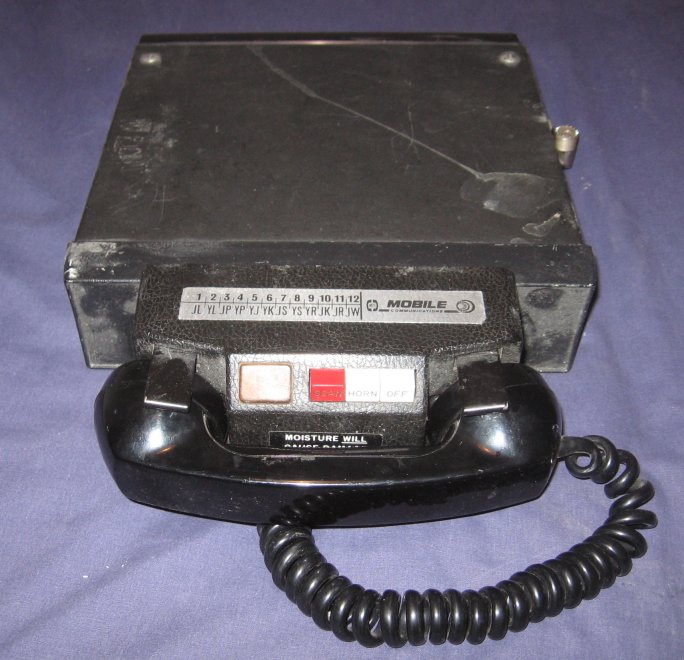 |
| A mobile radio telephone. |
No comments :
Post a Comment